What the Counter Taught Them: Chefs Who Got Their Real Education at the Deli
There's a particular kind of confidence that comes from standing behind a deli counter during a Saturday lunch rush. You've got six people in line, a roast beef that needs to hit exactly an eighth of an inch, a customer who wants her egg salad "not too wet," and a phone ringing about a catering order for forty. You don't panic. You just work.
For a surprising number of professional chefs, that pressure-cooker environment wasn't a summer job to forget — it was the foundation everything else was built on. Long before they touched a mandoline in culinary school or broke down their first whole duck, they were honing real skills at the deli counter. And many of them will tell you, quietly and with genuine conviction, that the counter taught them more than the classroom ever did.
The Knife Skills Nobody Talks About
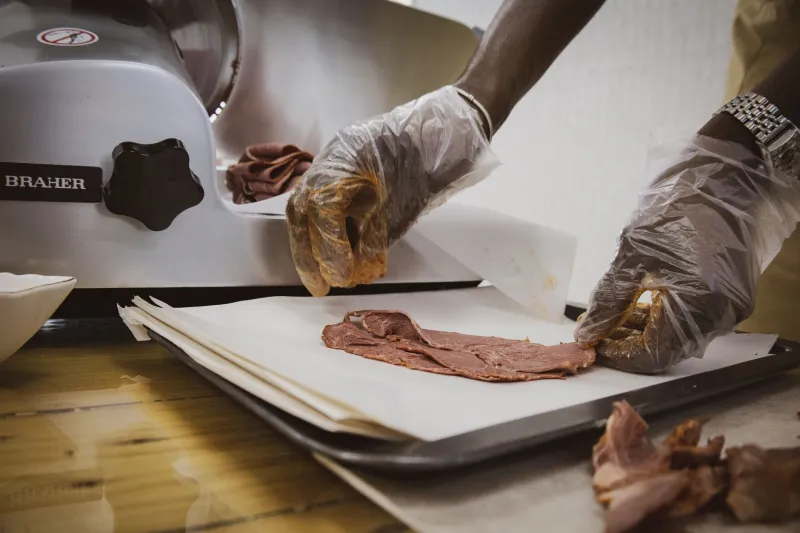
Ask any culinary instructor what separates a competent cook from a great one, and knife skills will be near the top of the list. What they don't always mention is that deli slicers — those humming, stainless-steel workhorses behind the counter — demand a level of precision that most home cooks and even some professional ones never develop.
Setting a slicer blade to 1/16 of an inch for prosciutto versus 3/16 for smoked turkey isn't guesswork. It's calibrated judgment. You learn to read the meat — its fat content, its grain, how it was cured — and adjust accordingly. Slice pastrami too thick and you lose the tenderness; too thin and it falls apart under the weight of the rye bread. That sensitivity to texture and thickness, developed through thousands of repetitions, is exactly the kind of tactile intelligence that good chefs rely on every single day.
Chefs who came up through deli work often describe a heightened awareness of how cut affects flavor. The way thin-sliced roast beef releases differently on the palate than a thicker cut. How shaved salami creates a different mouthfeel in a sandwich than hand-torn pieces. These aren't abstract culinary concepts — they're lessons learned by doing, over and over, while someone's waiting at the counter.
Reading an Ingredient Before You Touch It
One of the most underrated skills in any kitchen is the ability to assess an ingredient's quality before it ever hits a pan. Great deli workers develop this almost unconsciously. They learn to look at a bologna and know whether it's worth putting on the board. They can smell a smoked fish from two feet away and tell you if it's at peak freshness or a day past its best. They press a finger lightly into a pâté and understand its texture before they've sliced a single piece.
This is sensory education at its purest, and it's the kind of thing that culinary programs spend entire semesters trying to teach. At the deli counter, you learn it because the customer is standing right there and your reputation — and the shop's reputation — depends on you getting it right.
Meat selection, in particular, is a skill that translates directly to professional cooking. Understanding the difference between cuts, recognizing the marbling that signals flavor, knowing which preparations suit which proteins — all of it gets absorbed over time when you're handling dozens of different products every shift. Chefs who worked deli counters often describe walking into a butcher shop or a wholesale market with an instinctive read on quality that their peers had to work much harder to develop.
Seasoning by Feel, Not Formula
Recipes are useful. But the best cooks season by intuition — by taste, by smell, by years of understanding how flavors layer and balance. The deli counter is a crash course in exactly that.
Think about a well-made egg salad. The ratio of yolk to white, the amount of mayo, the hit of mustard, the salt, maybe a little celery for crunch. There's no universal formula. Every deli has its own version, and the person making it has to taste and adjust constantly, reading the batch as it comes together. Same goes for chicken salad, tuna salad, coleslaw, potato salad. These are humble dishes, but making them well — making them taste like something — requires real seasoning instinct.
Chefs who spent time in deli prep kitchens often cite this as a turning point in their development. Learning to trust their palate. Learning that a dish isn't done until it tastes right, not just until the recipe says so. That's a lesson that carries through every cuisine, every technique, every kitchen they'll ever work in.
The Customer as Teacher
Here's something culinary school doesn't fully prepare you for: cooking for real people, in real time, with real opinions. The deli counter does.
Every customer who asks for their sandwich "just like last time" is teaching you the value of consistency. Every person who sends back a portion because it wasn't what they expected is teaching you to listen more carefully. Every regular who trusts you to make their order without being asked is teaching you what it means to earn someone's confidence through your craft.
This customer-facing dimension of deli work builds a kind of culinary empathy that's hard to manufacture in a professional kitchen, where cooks often never see the people eating their food. At the counter, the feedback loop is immediate and personal. You know when you've nailed it. You know when you haven't. And you adjust.
Chefs who came up this way tend to be more attuned to the people they're cooking for — more willing to modify, more interested in what the guest actually wants rather than what the menu dictates. That hospitality instinct, rooted in years of counter work, often defines their style long after they've left the deli behind.
Why the Deli Deserves More Credit
America has a long tradition of treating deli work as a stepping stone rather than a destination — something you do before your "real" career starts. But the chefs who passed through those counters and went on to build serious culinary careers tend to see it differently. They remember the deli as the place where they first understood what it meant to really work with food.
The precision. The sensory awareness. The seasoning instinct. The human connection. These aren't supplementary skills. They're the core of what good cooking actually is.
At Towne Deli, we think about this a lot. Every sandwich that goes out over our counter carries the same kind of craft and attention that those chefs describe from their early days. The person making your lunch isn't just assembling ingredients — they're making decisions, dozens of them, based on experience and care and a genuine desire to get it right.
Next time you're at the counter, maybe take a moment to watch. There's more happening back there than most people realize. And there's a reason so many great chefs still talk about it like it was the best school they ever attended.