Standing in Line Is the Best Thing That Ever Happened to Your Social Life

Photo: Solomon203, CC BY-SA 4.0, via Wikimedia Commons
You walked in for a turkey club. You walked out knowing which elementary school has the best principal, which plumber actually shows up on time, and that the old hardware store two blocks over is getting converted into something — nobody's quite sure what yet, but the guy ahead of you in line has a theory.
That's the deli for you.
There's no algorithm curating what you hear. No engagement metric deciding what's relevant to your neighborhood. Just a room full of people who happen to live near each other, waiting on their lunch, and filling the time the way humans have always filled time — by talking.
The Line Is Where the Real News Lives
Your local paper might cover the big stuff. Social media might surface the dramatic stuff. But the deli line? That's where you get the useful stuff.
Who's selling their house. Which new restaurant actually lives up to the hype. Whether the road construction on Elm is going to be done before the holidays (spoiler: probably not). The kind of hyperlocal intelligence that no app has figured out how to replicate, because it doesn't come from data — it comes from people who actually walk these streets every day.
Regulars at neighborhood delis have long functioned as informal neighborhood correspondents. They're not trying to be. It just happens naturally when you put the same group of people in the same room on a regular basis and give them something to do while they wait — namely, talk.
And unlike social media, nobody's performing. Nobody's crafting a take or chasing likes. It's just conversation, which turns out to be a surprisingly efficient way to actually learn things.
What You Overhear Matters More Than You Think
Some of the best community intelligence isn't even directed at you. It's the stuff you catch drifting over from the next person in line.
A recommendation for a dentist who's actually good with nervous patients. A warning about a landlord who's notorious for ignoring maintenance requests. Word that the farmers market is adding a new Saturday vendor who makes genuinely life-changing hot sauce. You weren't part of that conversation, but now you're better informed about the place you live.
This is ambient community knowledge, and it's one of the quiet gifts of spending time in a genuinely local space. The deli isn't broadcasting it intentionally. It just accumulates there, the way warmth accumulates in a room full of people.
Online ordering is convenient. Nobody's arguing otherwise. But it delivers your sandwich without any of this. You get the food. You miss everything else.
The Counter Staff Knows More Than You Do
If the line is the community's informal news wire, the folks behind the counter are its long-running editors.
Think about it. They talk to dozens of people every single day. Regulars who've been coming in for years. New faces who just moved to the neighborhood and are still figuring out where everything is. People who are excited, people who are stressed, people who want to chat and people who just want their sandwich — and even the quiet ones usually say something while they wait.
After enough years, the people who work a deli counter develop a kind of encyclopedic awareness of the neighborhood's rhythms. They know when school's out because the lunch rush shifts. They know which local businesses are struggling because the owners start ordering smaller. They notice when a regular stops coming in and, sometimes, they're the first ones to check in.
That's not a feature any delivery app offers. It's something that only exists in a place where people actually show up.
Why Strangers Talk to Each Other Here
There's something about the physical setup of a deli that makes conversation happen more easily than almost anywhere else.
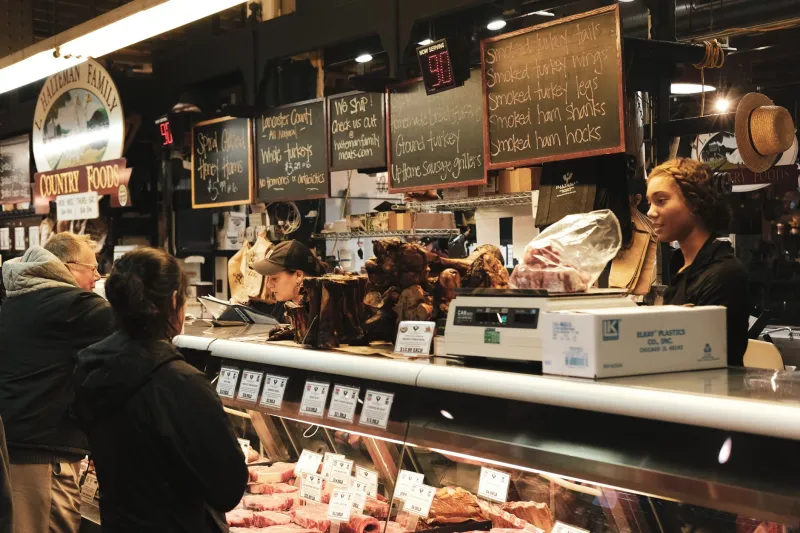
You're standing close together, oriented toward a shared focal point — the counter, the menu board, the glass case full of prepared foods. You're all waiting for the same basic thing. The environment is warm and smells incredible, which doesn't hurt. And there's a natural, low-stakes opening built right into the situation: the menu.
What's good here? Is the pastrami worth it? How long does the line usually move?
These are easy first questions that lead, more often than not, to actual conversations. Not the polite, going-nowhere kind, but the genuinely interesting kind — where you find out the person next to you grew up in this neighborhood, or just moved here from across the country, or has been getting the same exact sandwich every Tuesday for eleven years and has strong feelings about why.
Delis have always attracted a cross-section of the community that most spaces don't. The contractor and the graphic designer and the retired teacher and the new parent with a stroller — they're all in the same line, and the line has a way of leveling things out.
A Shared Table, Even When You're Standing
There's a phrase that gets used a lot in discussions about community: third places. Not home, not work, but the spaces in between where social life actually happens. The barbershop. The park. The coffee shop. The deli.
What makes a third place work isn't the product it sells. It's the regularity of the gathering. The sense that you can show up and find familiar faces, even if you don't know their names. The feeling that you belong to something larger than your own front door.
The deli line, for all its mundanity, delivers that feeling reliably. You're not just picking up lunch — you're briefly, casually, genuinely participating in the life of your neighborhood. You're in the mix. You're part of the thing.
And sometimes you leave knowing exactly which plumber to call.
Don't Skip the Wait
Next time you're at your local deli and the line stretches back toward the door, resist the urge to pull out your phone and disappear into it. Look up. Say something to the person next to you. Ask the counter staff what they'd recommend today.
You came in for a sandwich. But the neighborhood is right here, ready to tell you everything it knows — if you're willing to stand still for a few minutes and listen.
That's the art of the deli conversation. And it doesn't cost you anything extra.